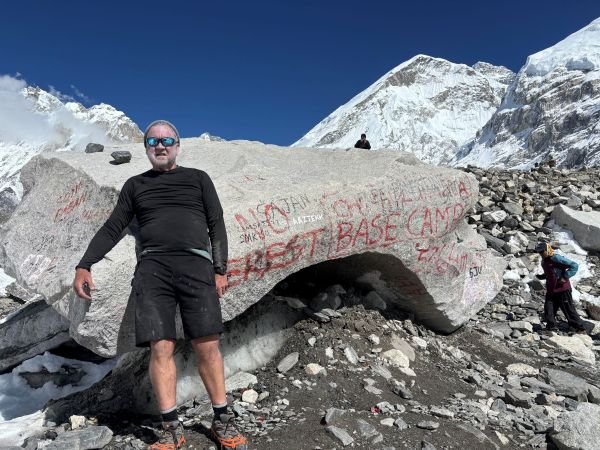
An infected knee replacement left lifelong athlete Scott Beasley stuck on the couch and unsure he would ever ride a bike again. After revision surgery and a patient-paced recovery with Dr. Kyle Stoops, he spent 13 days trekking to Mount Everest Base Camp and back.
Key Takeaways
- After a knee replacement at another practice led to repeat surgeries and an infection around the implant, 64-year-old athlete Scott Beasley could barely bend his knee.
- Revision joint replacement is a 're-do' surgery that repairs or replaces a failed implant, and it is often more complex than a first-time knee replacement.
- Dr. Stoops replaced Scott's implant, treated the infection with antibiotics, and built a gentler, more gradual physical therapy plan around Scott's needs.
- In October 2025, Scott hiked about 85 miles over 13 days to Mount Everest Base Camp and back, reaching roughly 17,500 feet.
- Dr. Kyle Stoops is a board-certified, fellowship-trained joint replacement surgeon serving Indianapolis-area and Terre Haute, IN patients, with deep experience in complex revision joint replacement cases.
A Lifelong Athlete Facing a Setback
For most of his life, 64-year-old Scott Beasley has measured himself by finish lines. The Brownsburg, Indiana, athlete has competed in the Ironman triathlon in Kona, Hawaii, five times. He has run the Boston Marathon five times. He has logged countless miles on his bike and climbed mountains for the challenge of it. For Scott, staying active is not a hobby. It is how he lives. So when a knee replacement at another practice went wrong, he stood to lose far more than a working knee.
When a Knee Replacement Goes Wrong
Scott expected his knee replacement to get him back on the road. Instead, it led to one setback after another. He needed more surgeries. His body was slow to heal. He spent long stretches on the couch, which is a hard place for an endurance athlete to be.
Then came the most serious problem. An infection developed around the implant in his left knee. (An implant is the set of artificial parts that replaces the damaged surfaces of the joint.) At its worst, the infection put Scott at risk of losing part of his leg.
Even on good days, his knee barely moved, and the longtime cyclist began to wonder whether his riding days were over.
'During 2023, I didn't think I was ever going to ride again because I couldn't get any bend in my knee,' said Scott.
A Friend's Referral Leads to Dr. Stoops
In 2024, a friend pointed Scott toward Dr. Kyle Stoops at Indiana Orthopedic Institute (IOI). Dr. Stoops is a board-certified, fellowship-trained joint replacement surgeon with deep experience in complex revision cases.
Revision joint replacement is a 're-do' surgery. It repairs or replaces a joint implant that has failed. These operations are often harder than a first-time knee replacement, because the surgeon may need to work around infection, scar tissue, or bone loss.
From the start, Dr. Stoops understood what mattered most to his new patient.
'Scott was sent to me to help him with his infected knee replacement. He wanted to stay active but never thought he would be able to get back to some of the activities that he enjoyed,' Dr. Stoops said.
Revision Surgery to Clear the Infection
Because the infection involved the implant itself, the old parts had to come out. Dr. Stoops replaced Scott's knee implant and treated him with antibiotics to clear the infection.
In revision cases like Scott's, the goal is to protect as much healthy bone and soft tissue as possible while placing specialized implants built for a secure, lasting fit. It is careful, detailed work, and it gave Scott a fresh foundation to rebuild on.
A Recovery Plan Built Around Scott
Surgery was only part of the story. After his earlier operations, physical therapy (PT) had left Scott feeling worn down, which made it tough to keep pushing forward.
'I would walk out of there completely swollen,' he said.
Dr. Stoops took a gentler path. He set Scott up with shorter, more gradual therapy sessions, so Scott could make steady progress without getting knocked back. He also gave Scott his personal cell phone number. If questions or worries came up during recovery, help was only a call away.
Step by step, Scott's knee got stronger. And before long, he was setting big goals again.
13 Days on the Trail to Everest Base Camp
In October 2025, Scott flew to Kathmandu, Nepal. From there, he took a small plane to the mountain town of Lukla, the starting point for the trek. Over the next 13 days, he hiked about 85 miles to Mount Everest Base Camp and back, reaching an elevation of around 17,500 feet.
The trail never let up. It would climb thousands of feet, only to drop back down and climb again. The air was thin, the ground was rough, and every step took balance and focus. But Scott's knee was not what held him back.
'The knee was the least of my problems,' Scott said of the trek. His real challenges on the mountain were the rocky trail, keeping his balance, and catching his breath at high altitude.
Just a few years earlier, Scott wondered if he would ever ride a bike again. Now he was doing what he loves most: pushing his limits, on his own two legs, in one of the most demanding places on Earth.
Is a Past Joint Replacement Holding You Back?
Your goal might be a trek through the Himalayas, a long ride with friends, or a walk around the block without pain. If a previous knee or hip replacement is causing pain, stiffness, swelling, or instability, a second opinion from an experienced revision surgeon can help you understand your options.
Request an appointment with Dr. Kyle Stoops at his Indianapolis Metro office in Noblesville or his Terre Haute office, or call (317) 620-0232. You can also learn more about revision joint replacement with Dr. Stoops.
Frequently Asked Questions
What is revision knee replacement?
Revision knee replacement is a 're-do' surgery that repairs or replaces a knee implant that has failed. It is often more complex than a first-time knee replacement because the surgeon may need to work around infection, scar tissue, or bone loss.
What are signs that a knee replacement may have failed?
Ongoing pain, stiffness, swelling, or instability after a knee or hip replacement can be signs that something is wrong with the implant. Limited ability to bend the knee, like Scott experienced, is another warning sign. An evaluation with an experienced revision surgeon can help pinpoint the cause.
How is an infected knee replacement treated?
Treatment depends on each patient's situation. In Scott's case, the infection involved the implant itself, so Dr. Stoops removed the old parts, placed a new knee implant, and treated him with antibiotics to clear the infection.
Can I stay active after revision joint replacement?
Many patients set active goals after revision surgery, though individual outcomes vary. With a recovery plan built around his needs, Scott went from struggling to bend his knee to trekking about 85 miles to Mount Everest Base Camp and back.
Can I get a second opinion on a joint replacement done by another surgeon?
Yes. Scott's original knee replacement was performed at another practice before a friend referred him to Dr. Stoops. If a previous knee or hip replacement is still causing problems, a second opinion from an experienced revision surgeon can help you understand your options.
Where does Dr. Kyle Stoops see patients?
Dr. Stoops sees patients at his Indianapolis Metro office in Noblesville and his Terre Haute office. Request an appointment online or call (317) 620-0232.
Scott's story was originally featured by Indiana Orthopedic Institute.
This blog is intended for general informational purposes. Any health-related information shared is not meant to provide or replace professional medical advice and does not establish a patient-provider relationship. Individual outcomes vary. If you are experiencing a medical emergency, call 911 or go to the nearest emergency room.
